From Lyrics to Life Skills: How Songs Support Daily Communication
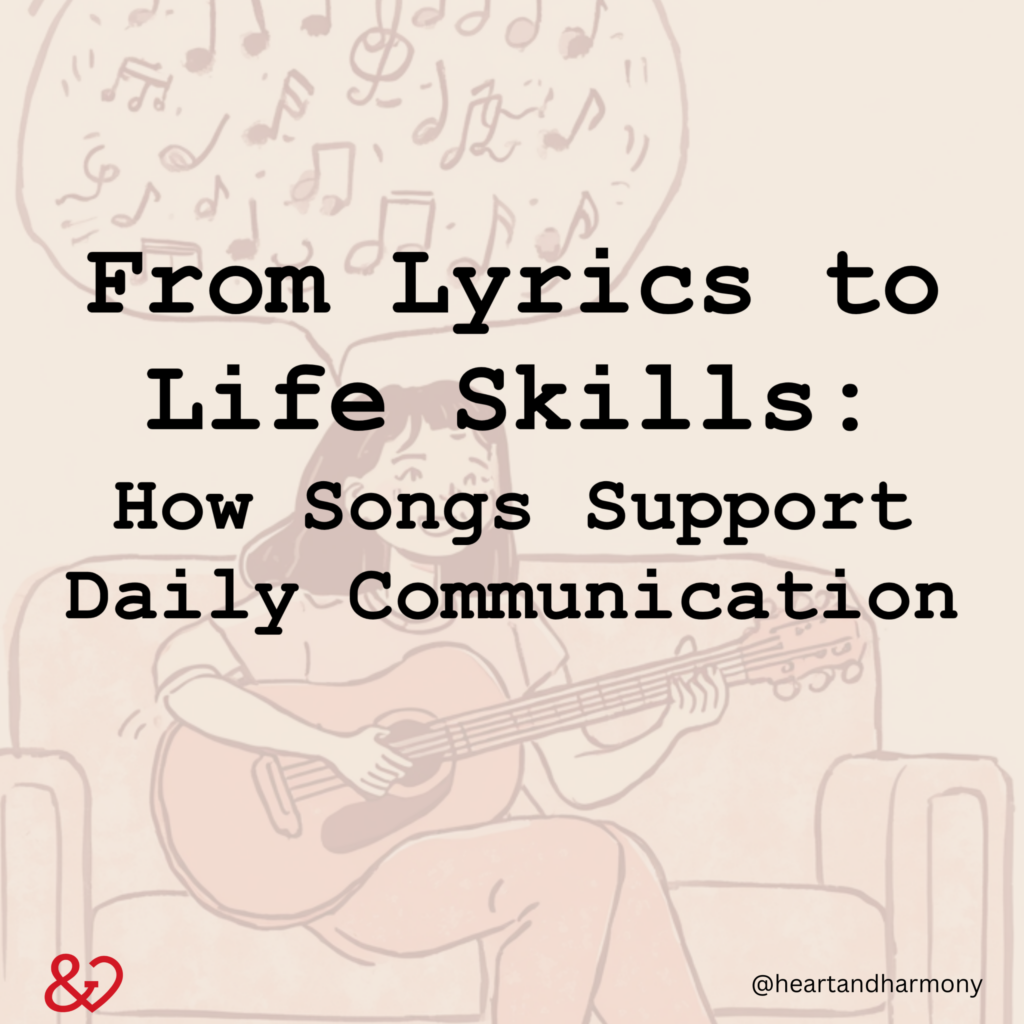
From Lyrics to Life Skills: How Songs Support Daily Communication
by Berkley Coscia, Music Therapy Intern
What Are Functional Phrases?
Being able to communicate needs, feelings, and choices is something many people take for granted. Phrases like “I’m hungry” or “I need a break” may seem simple, but for some individuals, these phrases can be harder to learn, remember, or use in the moment. These statements carry a lot of meaning in everyday life, and through music therapy, they can become more accessible when they’re used in songs. Functional phrases are short, practical, everyday expressions used to support communication, behavior, and daily life skills. Music therapists may intentionally incorporate these phrases into individualized interventions to address communication, cognitive, emotional, and social goals (American Music Therapy Association, n.d.). In sessions, clients have repeated opportunities to hear and practice these phrases with the ultimate goal of using them independently in everyday life. They can be spoken, rhythmically chanted, or my favorite, sung!

Why They Work
Incorporating functional phrases in music therapy interventions can be effective because of the way our brains process music. Different aspects of music, such as melody, language, and rhythm, are processed by interconnected brain networks working together (Pastuszek-Lipińska, 2025). When a client sings a functional phrase, they may hear the words, see a visual aid, and move to the music simultaneously. Engaging multiple senses at once helps the brain process and remember the phrase more effectively (Wan & Schlaug, 2010).
A valuable aspect of music therapy is that music is naturally motivating for many people. Think about how quickly a favorite song can capture your attention or improve your mood. This response can occur because preferred music can release dopamine, the “pleasure” hormone. The areas of the brain that produce dopamine are also responsible for motivation, reward, and learning (Stegemöller, 2014). When we enjoy something, we are more likely to want to do it again. When clients enjoy the music being used, they are often more willing to participate, giving them more opportunities to practice challenging skills. Over time, this repeated motivational practice can strengthen recall and increase the likelihood that the functional phrase will be used independently outside of the music therapy session.
Repetition is essential for learning new skills, but simply repeating the same phrase in conversation can quickly become boring or frustrating. Music naturally incorporates repetition in a way that feels engaging and motivating. Research has consistently shown that repeated exposure improves learning and recall by reinforcing new information each time it is practiced, making it easier to remember and apply in everyday situations (Musfeld et al., 2023). Repeating a functional phrase through music often feels more like participating in a favorite activity than completing a lackluster task.
Clinical Applications and Implications for Music Therapists
Functional phrases are versatile and can be adapted for clients of all ages across a variety of clinical settings. When a music therapist plans to introduce functional phrases in a session, it is important for them to consider the client’s current communication abilities, environment, and immediate needs. A music therapist should ask themself, “What communication skills will have the greatest impact on this person’s daily life?” Although many functional phrases are commonly used, no universal list works for everyone. For example, a client who has difficulty initiating social interactions may practice functional phrases like “Hello!”, “How are you?”, or “Can I play?”, while another client who has a need for practicing setting boundaries may benefit more from working on “No, thank you,” or “Please stop.” Selecting phrases that are vague, yet direct, help them become more generalized outside of sessions. Generalization also takes time and repetition. A client may first learn a new functional phrase with significant support, such as visual cues or verbal prompts. As the client becomes more confident and familiar with the phrase, the music therapist can phase out these supports, encouraging the client to use the phrase more independently.
Example in Practice
As an intern, I have implemented functional phrases with an Autistic client, whom I’ll call Matthew. Two of his current communication goals are to say “Please turn off the lights,” and “I am hungry.” These have been the focus of recent sessions because these are highly relevant to Matthew’s current daily life.
While functional phrases can sometimes be found in existing songs, like Moana’s “You’re Welcome” or “I Got You (I Feel Good)” by James Brown, another effective strategy is to rewrite familiar songs while keeping the original melody and song structure. This allows the intervention to stay engaging while targeting specific communication goals. In this case, I rewrote “I Want Candy” by The Strangeloves to include “I am hungry,” and my co-intern, Annamarie rewrote “Livin’ La Vida Loca” by Ricky Martin to include “Please turn off the lights.” We placed the phrases in the choruses because they repeat most often, giving the client multiple opportunities to practice in a short amount of time.

When introducing “I am hungry,” I used a visual aid that broke the phrase into syllables for greater support and accessibility. We also role-played and discussed what it feels like to be hungry, when Matthew might need to communicate that, and to whom. I then modeled the song and left a fill-in-the-blank pause for him to respond, pointing to each syllable as he sang or spoke the phrase.
Over time and across sessions, I began fading the visual support and only used the musical pause as a cue. This gradual reduction in prompting has helped increase Matthew’s independence and he is becoming more confident using the phrase.
Small Phrases, Big Impact
Functional phrases may be simple, but they can have a meaningful impact on communication when used intentionally in music therapy. By combining repetition, motivation, and musical structure, these phrases can become easier to practice, remember, and use in everyday life. When music therapists thoughtfully select client-centered phrases and support generalization across settings, they help bridge the gap between the music therapy space and real-world communication. Ultimately, functional phrases are more than just words in a song; they are tools that can support independence, self-expression, and connection beyond the music.
Do you support your clients’ communication goals with functional phrases? If so, drop us a comment and let us know what works well in your practice!

Berkley Coscia,
Music Therapy Intern
berkley@heartandharmony.com

References
American Music Therapy Association. (n.d.). What is music therapy? https://www.musictherapy.org/about/musictherapy/
Musfeld, P., Souza, A. S., & Oberauer, K. (2023). Repetition learning is neither a continuous nor an implicit process. Proceedings of the National Academy of Sciences of the United States of America, 120(16), e2218042120. https://doi.org/10.1073/pnas.2218042120
Pastuszek-Lipińska, B. (2025). The role of musical aspects of language in human cognition. Frontiers in psychology, 16, 1505694. https://doi.org/10.3389/fpsyg.2025.1505694
Stegemöller, E. L. (2014). Exploring a neuroplasticity model of music therapy. Journal of music therapy, 51(3), 211–227. https://doi.org/10.1093/jmt/thu023
Wan, C. Y., & Schlaug, G. (2010). Music making as a tool for promoting brain plasticity across the life span. The Neuroscientist : a review journal bringing neurobiology, neurology and psychiatry, 16(5), 566–577. https://doi.org/10.1177/1073858410377805
The post From Lyrics to Life Skills: How Songs Support Daily Communication appeared first on Heart and Harmony Music Therapy.